.svg "logo (2)")
"Me, a Managing Engineer? I wasn't sure about that in the beginning," says Ole Wehrmeyer. He adds: "I didn't want to become someone who no longer has any clue how the day-to-day coding works. And managing older, more experienced colleagues? At first, that felt a bit weird."
But he overcame his hesitations and is now one of four PRISMAtes who just completed PRISMA's first Engineering Manager Development Programme.
The Sustainable Choice
The programme was created because PRISMA's team had grown to a point where it simply needed dedicated Engineering Managers.
T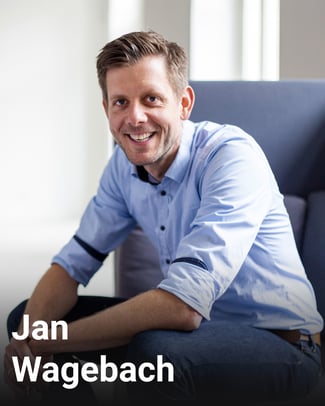 he fastest solution could have been to hire externally. "But an outside manager starts from zero: on the culture, the unwritten rules, who trusts whom and why. Building that takes time," says Jan Wagebach, PRISMA's CTO, who was squarely confronted with the problem. "And during that time, uncertainty spreads."
The other obvious move: take the strongest engineer, hand them a title, and move on. But Jan was equally unconvinced. "Promoting someone into a new role without making sure they're equipped for it is not a promotion. It feels more like a setup; unfair to the engineers, and unfair to the people they'd be leading."
That meant one thing: build a development programme. Equip the right people, from the inside. And do it properly — not as a staffing mechanism, but as a genuine investment. If it turns out the role is not the right fit, stepping back to engineering is explicitly supported, without stigma.
Six Months to Become a Leader
The programme ran over six months, designed to happen alongside the job. Sessions were held partially online, partially in person at the Leipzig office. The content covered four areas led by internal teams: PRISMA's leadership culture and values, the full employee lifecycle from hiring and onboarding all the way to offboarding, finance and controlling, and company strategy and objective setting. Each participant was also assigned a dedicated mentor from within PRISMA's existing leadership team — someone to work with one-on-one from the very start, on their own terms and their own schedule.
Alongside that, eight remote coaching sessions with an external trainer tackled the human side of leadership: how to adapt your style to different situations, how to make conflict productive, how to deliver feedback, how to hold people accountable while still enabling their autonomy, and how to deliver bad news. Topics that are hard to learn from a slide deck and even harder to get right the first time.
New Territor
The first cohort brought together four engineers from across the company: Christian Flamm and Ole Wehrmeyer as Software Engineers, Benedikt Kaiser as DevOps Engineer — who first joined PRISMA as a working student — and Marvin Stickel as Frontend Developer. Different specialisms, same step forward.
Marvin Stickel had his own reason for stepping forward. "The surge of AI is changing the landscape for engineering roles," he says. "In the future, what sets engineers apart will be either very deep specialisation or taking on responsibilities like people management. I want to make sure I'm still a lighthouse in a future world full of AI coworkers."
Christian Flamm's motivation was about scope. "I like the idea of expanding into other areas of expertise, while still remaining a software engineer," he says. "Also, I've been drawn to the people-focused aspect of our jobs for a long time."
That curiosity in all four of them was something Marlucio Pereira noticed immediately.
"What stood out for me over the six sessions was the genuine curiosity," explains Marlucio Pereira, Tech Recruiter at PRISMA. "They were leaning into recruiting, onboarding, salary conversations and feedback talks from a completely new angle." Together with Victoria Schuster, Head of People & Culture, he ran six sessions with the cohort.
Meet the Participants


Not all of it felt comfortable right away. Marvin had wondered whether a frontend engineer could genuinely be responsible for backend engineers' careers. "In the company, there are many more backend engineers than frontend," he explains. "I wasn't sure how I would be able to fit in. Ultimately, I realised that I didn't need to worry about this so much — even the few frontend roles can benefit hugely from sharing the management responsibilities with more people."
Ole remembers the moment the abstract idea of "I'll manage people" shifted into something more concrete. "That includes at some point telling someone they are being let go," he says. "And not only that — at some point someone I really enjoy working with will come and tell me they got another job." He pauses. "That still has me feeling a bit uneasy in anticipation."
What helped was knowing they wouldn't face those moments alone. "It was totally not based around competition," says Benedikt Kaiser. "We were discussing sensitive situations openly, knowing we'd always have support."
"We intended to teach them but it went both ways quickly," says Marlucio. "In the employer branding session, for example, one participant pushed us to think beyond 'good culture' and show more of the product itself and how it's built. That's the kind of insight you only get when you bring engineers into the room."
The other sessions covered the full range of what managing people actually means in practice. "Recruiting, onboarding, salary conversations, feedback talks — there is a lot of new territory when you step into a managing role," Marlucio adds.
The Moment Jan Knew
In the final workshop, the group reached a sensitive item on the agenda: redistributing direct reports among the four new Engineering Managers. In practice, that means deciding which colleagues each of them would now be responsible for — their development, their day-to-day challenges, their careers. Until very recently, these were peers. Equals. People they had worked alongside on the same level.
It is the kind of decision that carries real weight. And in most organisations, that weight shows. People have preferences they don't say out loud. They manoeuvre quietly toward the colleagues they'd rather have on their team, or away from the ones they find more challenging.
"In a lot of rooms," Jan says, "that kind of conversation brings out the bad instincts — people lobbying quietly, positioning carefully, saying the right things while calculating privately."
That is not what happened.
"What happened instead was an actual conversation. Open and honest, with no one performing and no one protecting turf." Jan pauses. "That was the moment I knew they were ready. Not because they had mastered a framework or passed a test but because the room felt like the kind of room good leaders create. And they had created it themselves."
Still Engineers. More Impact
In May 2026, at one of PRISMA's company-wide all-hands meetings, it became official: the new reporting structures were announced, and the four new Engineering Managers took on their direct reports. After six months, their new jobs started.
What changed now? Asking Ole, he says that inside his delivery team, he had already been the person others came to — for domain knowledge, for guidance, for help thinking something through. "The Engineering Manager role just lets me do that for more people and with a broader focus. More impact."
He still codes. He still sits with his team. He just also, now, leads people.